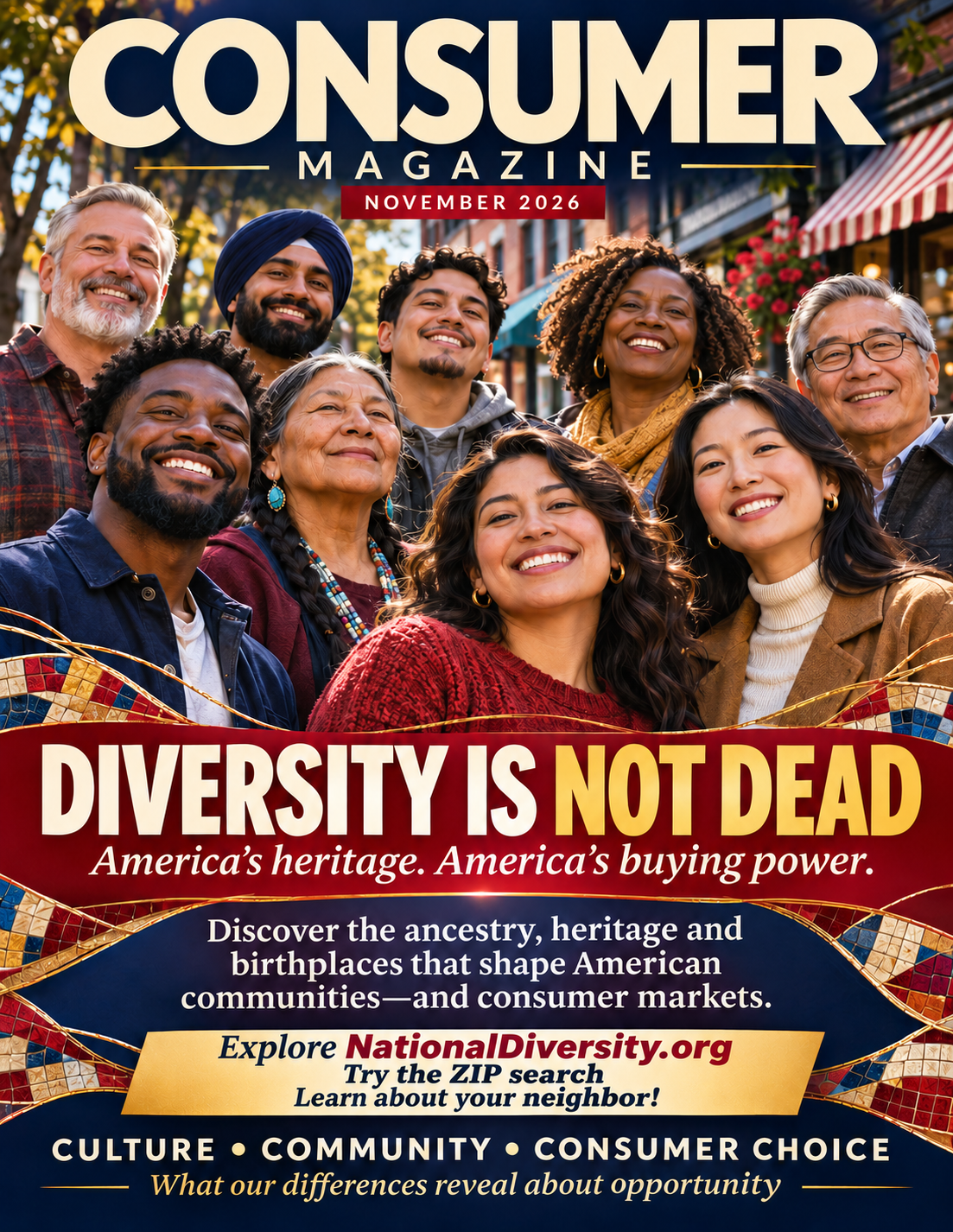
Diversity Is Not Dead: America’s People Are Still Its Greatest Strength
We do not have to agree on every policy to recognize one another’s humanity. We can debate laws and public choices while insisting that people be treated with dignity. America’s story has never been finished. It is being written by the people who live it every day.


America’s heritage. America’s buying power.
On Election Day 2026, the country is often described in colors on a map. Red here. Blue there. A winner in one place, a loser in another.
But walk down an American street and a different picture comes into view.
A veteran opens a neighborhood business. A grandmother tells a family story in one language while her grandchildren answer in another. A young couple looks for childcare. A business owner wonders whether customers can still afford what is on the shelves. A family with roots in Mexico lives near a family whose ancestors came from Germany, Nigeria, Vietnam, or the next county over. Indigenous families carry histories that reach far beyond the founding of the United States.
These are not competing versions of America. They are America.
That is why we chose this cover. Diversity is not dead. It is present in our families, neighborhoods, businesses, places of worship, schools, military units, and marketplaces. It remains part of the country regardless of the result of an election or the name an institution gives to a program.
The political conversation is real. Americans disagree about diversity, equity, and inclusion initiatives; immigration enforcement; trade policy; and the proper role of government. Those disagreements deserve serious discussion. They should not require us to pretend that the people living alongside us do not matter.
The numbers also remind us how much variety exists within the country. In its 2020 Census analysis, the Census Bureau estimated a 61.1% chance that two people chosen at random in the United States would be from different racial or ethnic groups, using the agency’s measure. That is a snapshot from 2020, not a ranking of individual neighborhoods or a measure of whether people feel included. It does, however, illustrate a country whose communities cannot be understood through a single story. [1]
The consumer is a person before the purchase
Every consumer is more than a data point. People bring their own budgets, tastes, traditions, and priorities to the marketplace. Some households care most about the price of groceries. Others are trying to find a home, care for an aging parent, start a business, or preserve a family tradition.
Businesses that listen can find opportunities to serve people better. That does not mean assuming every person in a community thinks or shops alike. It means asking better questions, welcoming more voices, and making products and services easier to use.
A grocery store might learn that customers want ingredients it does not carry. A hospital might discover that families need clearer information in more than one language. A small business might realize that the neighborhood around it has changed while its marketing has not.
Those are practical questions about service. They are also questions about whether people feel seen.
A ZIP code is a place to begin
With NationalDiversity.org, readers are encouraged to explore the communities that make up the places we call home. The site brings together selected measures of race and ethnicity, ancestry, heritage, origin, and birthplace, with community rankings and a ZIP search.
The search is a starting point. Its current ZIP display includes selected measures and leading entries in some groups; it is not yet a complete listing of every heritage. Census estimates have margins of error, and different measures can overlap. A ZIP code cannot tell us how a neighbor votes, what a family buys, or what a person believes.
To learn about your neighbor, start with the data—and then listen to the people.
The work continues after the vote
The day after an election, the need for affordable groceries will still be there. So will the need for good jobs, safe communities, strong schools, and businesses that can grow. Our differences will still be part of the country, and so will our shared responsibilities.
We do not have to agree on every policy to recognize one another’s humanity. We can debate laws and public choices while insisting that people be treated with dignity.
America’s story has never been finished. It is being written by the people who live it every day.
Diversity is not dead. It is who we are—and part of what we can build together.
Explore the ZIP search: